
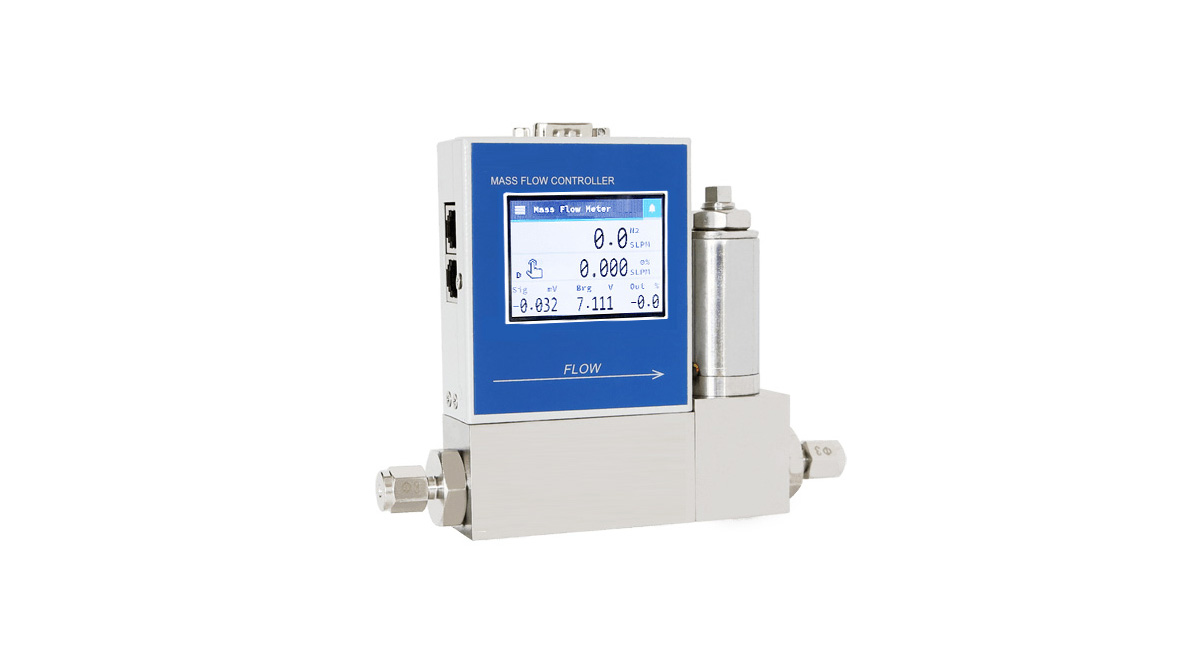
Selecting the right regulador de caudal másico térmico (MFC) is a critical decision in gas flow control systems. Whether used in laboratories, semiconductor manufacturing, hydrogen energy systems, analytical instruments, or industrial gas processes, an improperly selected MFC can lead to unstable flow, inaccurate dosing, excessive downtime, or even safety risks.
Unlike simple medidores de flujo, a thermal mass flow controller is an active control device that integrates measurement, control, and feedback into a single unit. This means its selection must consider not only flow measurement accuracy, but also control stability, response time, gas compatibility, and system integration.
This guide provides a step-by-step, engineering-focused approach to choosing the right thermal mass flow controller for your gas application.
Índice
1. Clearly Define the Purpose of Flow Control
The first and most important step is understanding why you need a thermal mass flow controller.
Ask yourself:
- Do you need precise gas dosing or just monitoring?
- Is the flow continuous or batch-based?
- Does the process require automatic adjustment when pressure changes?
- Is flow stability critical to product quality?
Typical applications that require a thermal MFC include:
- Gas mixing and blending
- Semiconductor and CVD processes
- Laboratory gas control
- Fuel cell and hydrogen testing
- Analytical instrumentation
- Calibration systems
If your application only requires flow indication, a thermal mass flow meter may be sufficient. If you need automatic, closed-loop control, a thermal mass flow controller is the correct choice.
2. Determine the Required Flow Range (Most Common Selection Mistake)
Flow range is the most frequently misunderstood parameter when selecting an MFC.
2.1 Define Minimum and Maximum Flow
You must identify:
- Minimum operating flow
- Normal operating flow
- Maximum required flow
Thermal mass flow controllers are typically specified by full-scale flow range, such as:
- 0–100 sccm
- 0–1 slm
- 0–50 slm
- 0–500 slm
2.2 Best Practice for Range Selection
✅ The normal operating flow should fall between 30% and 70% of full scale.
Why?
- Too close to zero → unstable control
- Too close to full scale → reduced accuracy and valve stress
For example, if your normal flow is 20 slm, selecting a 0–20 slm MFC is not ideal. A 0–50 slm unit provides better control margin and long-term stability.
3. Identify the Gas Type and Gas Properties
Thermal mass flow controllers are gas-dependent devices.
3.1 Gas Calibration Is Critical
Thermal sensors rely on:
- Thermal conductivity
- Specific heat capacity
Because these properties vary between gases, an MFC calibrated for nitrogen will not be accurate for hydrogen, oxygen, or CO₂ without proper conversion or recalibration.
You must specify:
- Primary gas (e.g., N₂, H₂, O₂, Air, CO₂)
- Any secondary or mixed gases
Some controllers support:
- Multi-gas calibration
- Gas conversion factors
- Digital gas selection
3.2 Special Gas Considerations
- Hydrogen: requires fast response, leak-tight design, and material compatibility
- Oxígeno: requires oxygen-cleaned components
- Gases corrosivos: may require special wetted materials
- Mixed gases: require known composition and stable ratios
Always confirm gas compatibility with the manufacturer.
4. Required Accuracy, Repeatability, and Control Stability
Accuracy is important—but it is often misunderstood.
4.1 Accuracy vs Repeatability
- Precisión: how close the reading is to the true value
- Repetibilidad: how consistently the controller maintains the same flow
In many gas processes, repeatability and control stability matter more than absolute accuracy.
Typical specifications:
- Accuracy: ±0.5–1.0% of full scale
- Repeatability: ±0.2% or better
If your process depends on consistent gas ratios or dosing, repeatability is the key parameter to focus on.
5. Response Time and Dynamic Performance
Response time defines how quickly the MFC reacts to:
- Setpoint changes
- Pressure fluctuations
- Upstream disturbances
5.1 Why Response Time Matters
Fast response is critical in:
- Batch processes
- Gas switching systems
- Semiconductor and analytical applications
However, extremely fast response may introduce:
- Control oscillation
- Valve wear
The best MFC balances speed and stability rather than being “as fast as possible.”
6. Operating Pressure and Pressure Drop
6.1 Inlet and Outlet Pressure
You must specify:
- Maximum inlet pressure
- Minimum outlet pressure
- Normal operating pressure range
Thermal MFCs require a minimum pressure differential across the control valve to function properly.
If inlet pressure fluctuates significantly, the MFC must be sized and configured accordingly.
6.2 Pressure Drop Considerations
Pressure drop affects:
- Upstream supply requirements
- Overall system efficiency
Higher flow ranges and smaller valve orifices increase pressure loss. This must be considered during system design.
7. Valve Type and Control Characteristics
The control valve is a core component of a thermal mass flow controller.
7.1 Common Valve Types
- Proportional solenoid valve
- Piezoelectric valve (for high precision)
- Normally closed vs normally open
7.2 Selection Considerations
- Low flow → small, sensitive valve
- High flow → larger valve or multi-stage control
- Safety-critical systems → normally closed valve preferred
Valve selection directly impacts:
- Flow stability
- Response time
- Leakage performance
8. Installation Orientation and Mechanical Integration
Before selecting an MFC, confirm:
- Pipe or tubing size
- Connection type (VCR, compression, threaded, flanged)
- Mounting orientation (horizontal / vertical)
Some thermal MFCs are sensitive to:
- Flow disturbances
- Vibration
- Contamination
Upstream filtration is often recommended to protect the sensor and valve.
9. Electrical Interface and Communication Protocols
Modern thermal mass flow controllers are designed for automation.
Common options include:
- Analog: 0–5 V, 0–10 V, 4–20 mA
- Digital: RS485, Modbus RTU, DeviceNet
- Setpoint input: analog or digital
You must ensure compatibility with:
- PLC
- DCS
- SCADA
- Lab controllers
Digital communication allows:
- Remote configuration
- Diagnostics
- Multi-gas selection
- Data logging
10. Environmental and Safety Requirements
10.1 Ambient Conditions
Consider:
- Ambient temperature
- Humidity
- Vibration level
Extreme environments may require:
- Remote electronics
- Rugged enclosures
10.2 Hazardous Area and Certifications
For hydrogen, flammable, or industrial gas applications, you may require:
- Explosion-proof design
- ATEX / IECEx certification
- Oxygen-cleaning compliance
Never overlook regulatory requirements during selection.
11. Maintenance, Calibration, and Long-Term Ownership Cost
A thermal mass flow controller is a long-term investment.
Key questions:
- How often is recalibration required?
- Can the sensor be cleaned?
- Is factory recalibration required?
- What is the expected service life?
A slightly higher upfront cost often results in:
- Lower downtime
- Better stability
- Reduced maintenance cost
12. Common Mistakes When Choosing a Thermal Mass Flow Controller
❌ Selecting based only on maximum flow
❌ Ignoring minimum controllable flow
❌ Using nitrogen calibration for all gases without correction
❌ Overlooking pressure drop
❌ No filtration for contaminated gas
❌ Choosing fastest response without considering stability
Avoiding these mistakes significantly improves system performance.
13. Final: How to Choose Thermal Mass Flow Controllers
Before finalizing your choice, confirm:
- Gas type and composition
- Required flow range (min / normal / max)
- Accuracy and repeatability requirements
- Response time expectations
- Operating pressure and pressure drop
- Valve type and fail-safe behavior
- Electrical interface and communication
- Installation and environmental conditions
- Certification and safety requirements
Choosing the right thermal mass flow controller requires a system-level perspective. It is not simply a flow meter with a valve—it is a precision control instrument that directly influences process stability, product quality, and operational safety.
By carefully evaluating flow range, gas properties, control performance, pressure conditions, and integration requirements, you can select a thermal mass flow controller that delivers reliable, repeatable, and efficient gas flow control over the entire lifecycle of your system.
When properly selected and installed, a thermal mass flow controller becomes one of the most reliable and valuable components in any gas flow control application.